Weak-Signal Amateur Radio Communications
from WØLCP
Radiating from EN35lj
- Stacy, Minnesota
This site last updated on 02/28/14

 This web page has been assembled for Radio Amateurs
located in the North Central US and Canada who are or would like to be involved
in VHF through light, weak-signal communications. With any
luck, you'll find something of use here, which will enable you to enjoy our
hobby to a greater extent. Below you will find links that
will lead you to other sites of interest. Hopefully, they
will encourage you to learn more about Weak-Signal Communications, VHF and up
Propagation, Microwaves, High Speed CW and Digital Modes for Meteor Scatter,
Computer Assisted Communications and much more.
This web page has been assembled for Radio Amateurs
located in the North Central US and Canada who are or would like to be involved
in VHF through light, weak-signal communications. With any
luck, you'll find something of use here, which will enable you to enjoy our
hobby to a greater extent. Below you will find links that
will lead you to other sites of interest. Hopefully, they
will encourage you to learn more about Weak-Signal Communications, VHF and up
Propagation, Microwaves, High Speed CW and Digital Modes for Meteor Scatter,
Computer Assisted Communications and much more.
So, what do you need?
The time? Ok, here are links to sites
offering software that will access a public time server and reset your computer
clock and keep it accurate within milliseconds. One is AboutTime , and the other is Dimension
4 . Both are clock-setting programs that are gaining in
popularity. They are very handy if you are running high-speed meteorscatter or
just need to check your computer or station clock.
Clubs
|
Another group here in the upper midwest are the, a group
of like-minded VHF/UHF/SHF weak-signal operators primarily in Wisconsin.
However, there are members in Illinois, Michigan, and
Minnesota as well. The group was formed initially as a way
to enjoy the club competition aspect of ARRL VHF contests.
But it has become more than that. It's a friendly group
that is helping each other with propagation openings and getting on new
bands. In east central Iowa, there's The Cedar Rapids Microwave Society , a
group of active radio amateurs who are doing interesting and creative things in
the regions above six meters. You'll find they are willing
and able to help you, and an enthusiastic bunch to work with.
For more info, contact: Steve, NAØIA
If your club is located in the upper midwest, I'd like
to list it here provided that it is VHF+ oriented. Drop me
a note with some details. |

Aurora Information
|
Space environment Home
Page This page provides links to a wealth of solar
terrestrial information including current auroral maps and files of maps for
previous days. One link [Email Products] will allow you to
subscribe to the NOAA Weather Wire, which provides alerts, warnings,
summaries, K and A index values, sunspot numbers, and other information that
changes every hour. You can also click on "ADDITIONAL PLOTS" for
real-time solar activity, updated every 1 or 2 minutes. For a quick check on the current auroral situation, try "OVATION Aurora".
This site has detailed info that is really spectacular. Another NASA website, the Laboratory for Astronomy and
Solar Physics offers a variety of information on Solar Flare Theory that
should help you understand the physics of aurora to a greater extent.
You can jump to an almost endless supply of information on
solar flares from here but be sure to check out the Table of Contents
at the bottom of the page for a fascinating short course. |
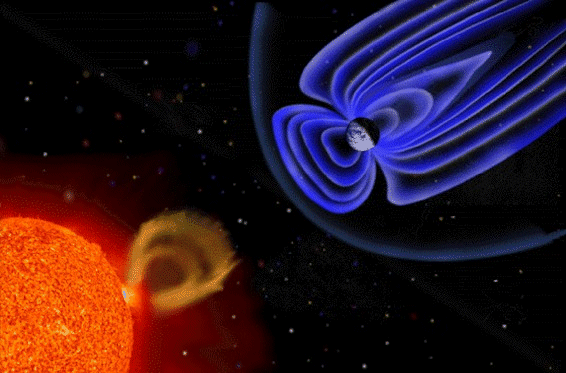
Solar Activity Monitor
Updated at 10 minute intervals.
Click
on the monitor window for a detailed view of current solar data.
|
Solar X-rays:
|
|
|


From maj.com
Weather and Tropospheric
Propagation Info
|
For weather radar information, you can try either the Intellacast
or the National
Weather Service webpages for a quick look at what is happening in your
area. These links access radar loops from Minneapolis,
but you can link to other cities from here, if you wish. With the increased interest in rain scatter on the
microwave bands, Tom Williams, WA1MBA has a good article called 10 GHz - A Rainy Day Band that
will be of value to you. For those interested in tropo, you'll find that William Hepburn's VHF/UHF Tropospheric
Ducting Forecast will give you a "heads up" on possible
enhanced tropo conditions for the next couple of days.
You'll find excellent maps covering most areas of the world here. |

nlrs_bar.gif
Microwave Info
|
A group
of hams have designed a DSP-10
Computer Controlled Two Meter Transceiver specifically for weak-signal
work. Check out the Sept/Oct/Nov 1999 issues of QST for
the all-mode transceiver construction article. This transceiver
can be used as a basic building block for use on any of the vhf and up,
bands. A parts kit is available through TAPR. This is
K3KGP's site and it's loaded with all sorts of interesting topics for the
experimenter. Construction,
Astronomy and News are just a few areas covered on this great site. Looking
for microwave components? Check out these sites for kits
and components. Down
East Microwave has a wide variety of kits and components for 50 MHz. and
above. W1GHZ has a website full of
interesting microwave information. He has also written an
online book on microwave antennas that should be of value to anyone
contemplating work at these frequencies. |
 This is
an area that is attracting more and more interest in the amateur community.
As the HF bands become more and more crowded, many hams
are moving higher in frequency to take advantage of the challenge of the
microwave bands.
This is
an area that is attracting more and more interest in the amateur community.
As the HF bands become more and more crowded, many hams
are moving higher in frequency to take advantage of the challenge of the
microwave bands.
Computer Assisted
Communications
|
PSK31 has
been around for a while and an excellent source of information can be found
at The PSK31 Home Page.
Check it out for a wide range of software and hardware
links. A weak signal software product designed for PSK31
that I found there, and have used myself, is DigiPan.
The reflector for PSK31
can be very helpful in getting started in this mode.
If you've tried PSK31, then WSJT is definitely your next step!
Have a look at K1JT's WebPages for a head
start in WSJT. Joe has created excellent software for
moonbounce, tropo and auroral communications.
Another site that will be of value to you are: NØUK's Ping-Jockey, a
Meteor-Scatter Chat Server where you can observe and/or participate in
current activity. |
|
This webpage is dedicated to my long-suffering
spouse who believes that I spend entirely too much time in front of a mike or
at the keyboard, talking to people who are almost as weird as I am. She's probably right. Now let's
see, where was I.... |