Updated March 31st 2014 2015z
HOMEPAGE OF VE3FAL
QRP IS NOT FOR SISSIES
YOU CAN DO SO MUCH WITH SO LITTLE
|
|
|

Hello and welcome to my homepage, thanks for stopping in. My name
is Fred Lesnick, my amateur radio call sign is VE3FAL, and I live in Thunder
Bay, Ontario. My grid square is EN58hh.
Radio has been a hobby of mine for many years, and every hour that
I spend playing radio is rewarding. My favorite digital mode is C.W. (Morse
code) , yes, C.W.. Some of the other modes I enjoy
are:
Slow Scan TV (S.S.T.V) , Radio Teletype
(R.T.T.Y) , PSK , Satellites , APRS , Moon Bounce and Meteor Scatter.
Here are some of my favorite
links:
Buddipole Homepage: http://www.buddipole.com/
Solar Weather Website: http://dx.qsl.net/propagation/
NA6E Website: http://www.qsl.net/na6e/ (God Bless you Mary, you were a great friend)
K6DF Website: http://www.qsl.net/k6df/index.html
DX Summit: http://www.dxsummit.fi/DxSpots.aspx
Radio World: http://www.radioworld.ca/
Durham Radio Sales: http://www.durhamradio.com
Radio Amateurs Of Canada: http://www.rac.ca/
Northern Lights Radio Society: http://www.nlrs.org
Central States VHF Society: http://www.csvhfs.org/
QRP ARCI Webpage: http://www.qrparci.org/
Eastern Pennsylvania QRP Club: http://www.n3epa.org/
How Far Is It (Distance Calculator): http://www.indo.com/distance/
6 Metres: http://www.6mt.com/
Numbers Stations: http://www.spynumbers.com/
Small Wonder Labs: http://www.smallwonderlabs.com/
QRP Homebuilders Page: http://www.qrp.pops.net/
Canadian Hurricane Centre: http://www.ec.gc.ca/ouraganshurricanes/default.asp?lang=En&n=DA74FE64-1
H.A.R.C. QRP Swap Shop: http://www.halifax-arc.org
PSK Site: http://aintel.bi.ehu.es/psk31.html
QRP ARCI: http://www.qrparci.org/
AMSAT: http://www.amsat.org/
Radio Habana Cuba: http://www.radiohc.org/
CFARS-Canadian Forces Affiliate Radio System: http://www.cfars.ca/
S.O.C Radio Club: http://www.qsl.net/soc/
Lakehead Amateur Radio Club (L.A.R.C): http://www.larclub.net/
Salvation Army Team Emergency Network (SATERN): http://www.satern.org/
VE3ONN Web Site (ARES): http://www.thunderbay.emergencyradio.ca/
Railroad Caboose Cars On The Air (R.R.C.C.O.T.A.): http://groups.yahoo.com/group/rrccota/
Railroad Depots On The Air: (R.R.D.O.T.A.): http://groups.yahoo.com/group/rrdota/
Radio Club 72: http://www.club72.su/
RU QRP Club: http://translate.google.ru/translate?hl=en&sl=ru&u=qrp.ru
HB-1A radio Users Group: http://ca.groups.yahoo.com/group/hb1a_radio_users/
Boundary waters Amateur Radio Club (B.W.A.R.C.): http://www.boreal.org/bwarc/
PODXS 070 PSK Club: http://www.podxs070.com/
How To Use an Antenna Tuner: http://www.hamuniverse.com/tuner.html
Ultra DX Home: http://ultradx.com/Home/tabid/83/Default.aspx
Little Thunder QRP Club - VE3LTQ
I hold the callsign for the Little
Thunder QRP Club here in Thunder Bay. A few fellow amateurs who enjoy the art
of QRP and homebrewing created the club. We are a no
bylaws or dues collecting club, we simply meet to talk about various aspects of
the QRP hobby. So listen for the club call on the air, and hope to work you
soon. The Little Thunder QRP Club now holds the FISTS # 10325, so will be using
that from time time in the contests.
You can visit the club website:
Little Thunder QRP Club: http://my.tbaytel.net/flesnick/LittleThunderQRPClub.htm
VA3SBB 10 Meter Propagation Beacon (No longer in service)
However the new call sign of VE3SEC is now being used by myself for my 10 meter propagation testing from Thunder Bay Ontario EN58hh. If you hear VE3SEC on 28.241 please do not hesitate to send your report to.
Fred Lesnick
2060 Hwy 61
Thunder Bay, Ontario Canada
P7J1B9
or email to : [email protected] or [email protected]
|
SOME OF THE CLUBS I BELONG TO (VE3FAL) |
||||||||||
|
QRP CANADA #11 |
MQFD #17 |
|
NORTHWEST QRP #493 |
|
|
|||||
|
ALASKA QRP #382 |
AMSAT #33629 |
|
N.J. QRP #140 |
|
|
|
||||
|
MI QRP #M1610 |
|
070 CLUB #355 |
|
GQRP #7560 |
|
|
|
|||
|
FISTS #2337 |
|
SIX CLUB #176 |
|
YLISSB # 15214 |
|
|
|
|||
|
TEN-TEN #58940 |
|
SPAR #79 |
|
SOC #107 |
|
|
|
|||
|
FP QRP #101 |
|
RAC #13958 |
|
NAQCC #23 |
|
|
|
|
||
|
SKCC #50 |
|
|
|
|
|
|
|
|
|
|
|
|
|
|
|
|
|
|
|
|
|
|
|
|
|
|
|
|
|
|
|
|
|
|
Society For The Preservation of Amateur Radio- http://www.spar-hams.org/
PropNET: If the band is open and nobody is transmitting, can anybody hear it?
Welcome to the next level of Amateur wireless innovation. PropNET is an ad-hoc wireless digital network established by experimenters who are excited to explore new frontiers in the invisible world around us.
Participants known as Probes will periodically transmit on an Anchor frequency (see list to the left). Any station that receives that transmission forwards the 'catch' to an Internet server that plots the event on a map hosted by findu (see Map Menu section to the left).
While an Amateur Radio license is required in order to be a transmitting participant (probes), unlicensed individuals are encouraged to participate as receive-only stations (lurkers), reporting what they capture. Click on the hyperlinks above to view real-time maps of participating stations.
Participation requires the use of a Windows-based computer with an available sound-card, a sound-card cable to connect your transceiver to your computer and the PropNetPSK client for your Windows-based computer. See the hyperlinks in the 'Quick Links' section to the left.
Additionally, you may wish to join the PropNET-Online mailing list that is found on YahooGroups.com. By doing so, you will be kept up to date on the project as a whole.
This map was from September 24, 2008 and shows all the paths on 30 meters. I am running 25 watts into a dipole, as you can see I am heard by many stations, and I am hearing these stations as well.
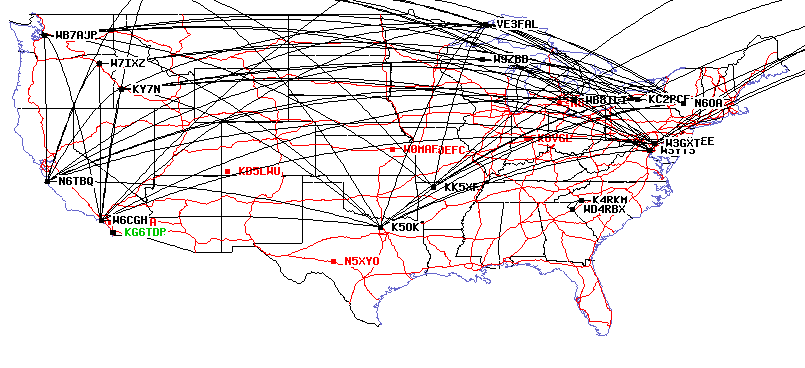
This chart shows the stations hearing each other and reports signal and things like offset etc…
|
Tx Call |
Tx Grid |
Rx Call |
Rx Grid |
Distance |
band |
offset |
imd |
Time Heard (UTC) |
|
K4RKM |
EM85vf |
N0OBG |
EM48ro |
515.5 |
HG |
-0005 |
-26 |
04/08/2008 20:16:29 |
|
VE3FAL |
EN58hh |
W3GXT |
FM19ol |
872.2 |
HG |
-0148 |
D60 |
04/08/2008 20:16:25 |
|
N0OBG |
EM48ro |
N0RQ |
EM13rg |
498.0 |
HG |
+0003 |
D99 |
04/08/2008 20:16 |
|
N0OBG |
EM48ro |
W3GXT |
FM19ol |
739.4 |
HG |
-0154 |
D80 |
04/08/2008 20:16 |
|
N0OBG |
EM48ro |
W3ABW |
FN20ot |
849.5 |
HG |
-0007 |
D80 |
04/08/2008 20:16 |
|
N0OBG |
EM48ro |
WA6MTZ |
DM14pw |
1464.6 |
HG |
-0011 |
D50 |
04/08/2008 20:15:59 |
|
N0OBG |
EM48ro |
K4RKM |
EM85vf |
515.5 |
HG |
+0004 |
-25 |
04/08/2008 20:15:58 |
|
K5OK |
EM13kf |
WA6MTZ |
DM14pw |
1124.6 |
HG |
-0072 |
D80 |
04/08/2008 20:15:21 |
|
K5OK |
EM13kf |
N0OBG |
EM48ro |
522.5 |
HG |
-0062 |
-25 |
04/08/2008 20:15:21 |
|
K5OK |
EM13kf |
W3ABW |
FN20ot |
1333.4 |
HG |
-0068 |
D60 |
04/08/2008 20:15:20 |
|
W3GXT |
FM19ol |
EN64db |
EN64db |
644.6 |
HG |
+0197 |
D99 |
04/08/2008 20:14:41 |
|
W3GXT |
FM19ol |
VE3FAL |
EN58hh |
872.2 |
HG |
+0148 |
D70 |
04/08/2008 20:14:41 |
|
W3GXT |
FM19ol |
WE2M |
EL99lc |
756.1 |
HG |
+0029 |
-24 |
04/08/2008 20:14:40 |
|
W3GXT |
FM19ol |
WE2M |
EL99lc |
756.1 |
HG |
+0029 |
-20 |
04/08/2008 20:14:40 |
What is encoded in the PHG value?
Keyboard PSK31 operators will often exchange information about their stations. Exchanges are often encoded in repetitive “brag files” that include their location, power output, antenna type, etc. PropNET operation encodes much of this same information in the payload, some of it is in the PHG.APRS users will recognize the PHG code concept. In PropNET, however, the code has been expanded to include the number of ID transmissions per hour. PropNET PHG code is actually a PHGDRA/ code (appearing, in order: Power,Height,Gain,Directivity,Rate,Altitude). The encoding of this information allows PropNET network participants to exchange station-information quickly and efficiently. The encoding table is shown below:
|
Code> |
0 |
1 |
2 |
3 |
4 |
5 |
6 |
7 |
8 |
9 |
Note |
|
Power |
0 |
1 |
4 |
9 |
16 |
25 |
36 |
49 |
64 |
81 |
1 |
|
Height |
10 |
20 |
40 |
80 |
160 |
320 |
640 |
1280 |
2560 |
5120 |
2 |
|
Gain |
0 |
1 |
2 |
3 |
4 |
5 |
6 |
7 |
8 |
9 |
3 |
|
Az |
Omni |
NE |
E |
SE |
S |
SW |
W |
NW |
N |
|
4 |
|
Rate |
0 |
1 |
2 |
3 |
4 |
5 |
6 |
7 |
8 |
9 |
5 |
|
ASL |
10 |
20 |
40 |
80 |
160 |
320 |
640 |
1280 |
2560 |
5120 |
6 |
In a typical PSK31 contact, an operator may pack their brag file with information that looks like this: "I am running 25 watts to a 4 element beam at 40 feet here in the high desert of Arizona" A PropNET participant's station can convey the same information by exchanging "PHG526649" along with a 6-character Maidenhead Grid locator.
Notes:
1: Square root of the TX power.
2: Log2 (H/10), where H is the antenna height above the local average terrain.
3: Antenna gain dBi. If more than 9dBi, use A=10, B=11, C=12 etc.
4: Azimuth of main antenna lobe.
5: Transmissions per hour. If more than 9 per hour, use A=10, B=11, C=12 etc.
6: Log2(h/10), where h is the height of the antenna above sea level.
To "manually" decode the PropNET PHG code, enter it in the webform here: http://www.pearhead.org/PropNET_PHGRA_decoder
Well there is a small primer to PropNet and propagation studies, a techie level up from 10 meter cw beacons for sure.
Thanks to Jeff Steinkamp N7YG for letting me use some of his material for this article and thanks to the PropNet website.

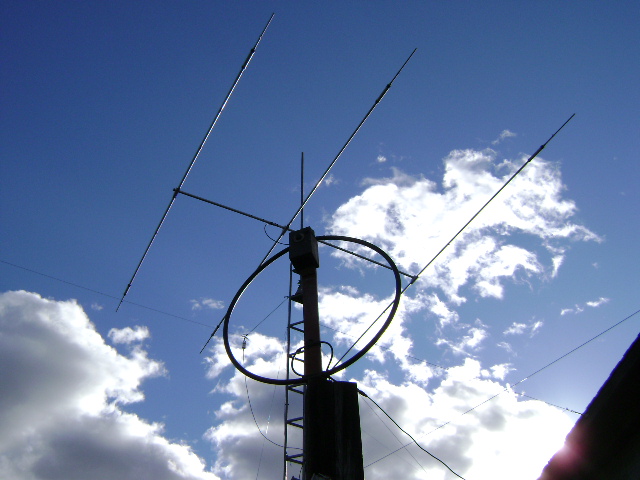
S.K.C.C. (W.E.S) Weekend Sprint Junk Box Key

http://www.nativesuntours.com/contact-us.html
Native Sun Tours
5300 S. Cherokee Way, Homosassa, FL 34448
Directions: From US 19, turn west on Halls River Road.
Turn left on Fishbowl going past the Homosassa Wildlife Park. Stay on Fishbowl,
which curves by the water tower and becomes Yulee Drive. Continue past the
Sugar Mill ruins on your right for approx. 1 mile. Native Sun Tours is located
at MacRae's on the Homosassa River.
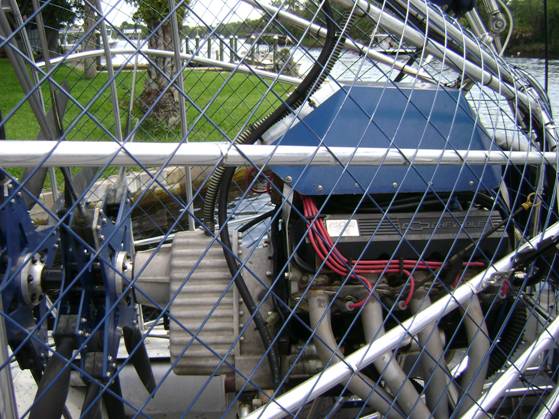
This
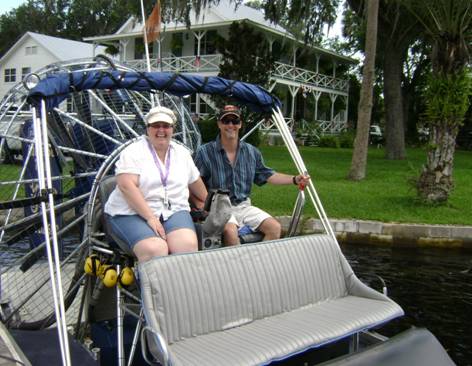
is the power plant that makes this thing hum across the water
Visit Capt. Russ
Holliday and have him take you on a most enjoyable and thrilling ride through
the everglades and out to The Gulf Of Mexico. He will show you and explain to
you about the wonderful aquatic and marine life that you see as you meander
through the everglades.
Thanks Capt. Russ for a
great tour
Fred and Teresa
http://radar-america.blogspot.ca/