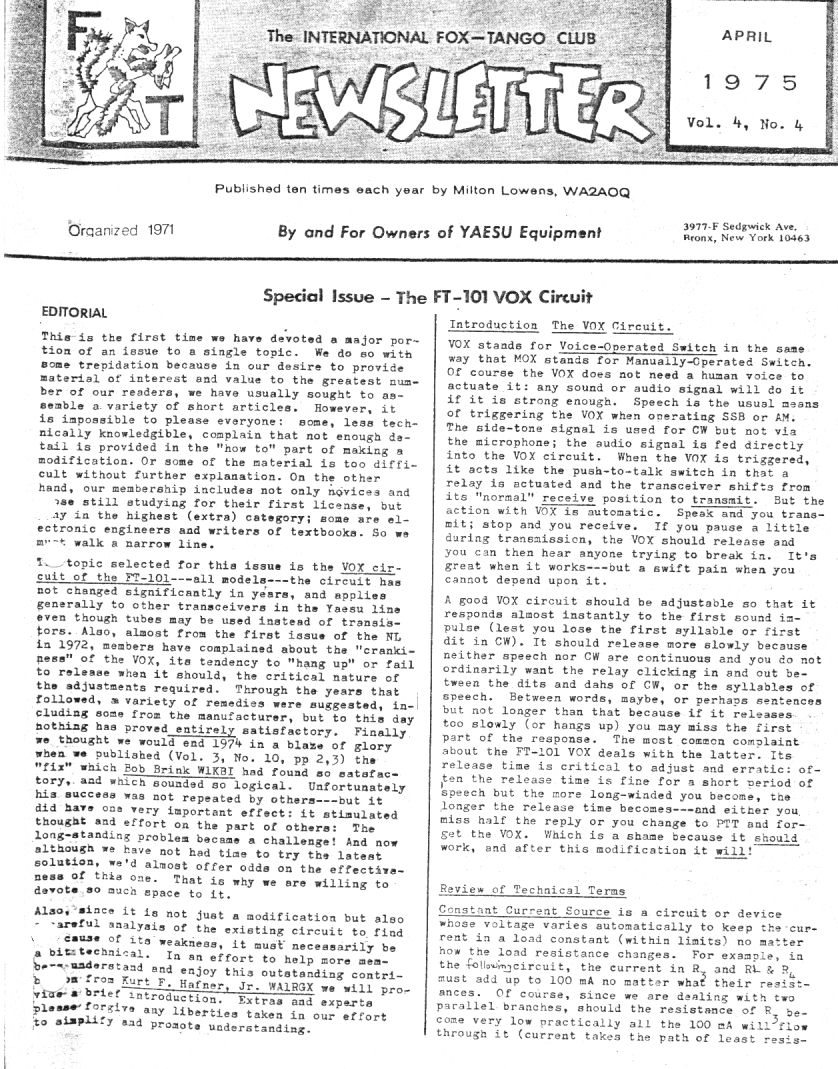
NW2M Presents:
The International Fox-Tango Club
and
The Fox-Tango Newsletters

Purpose
The purpose of this page is to highlight the largest collection of user and factory support information for any radio at any time. There were ten Fox-Tango Newsletters produced every year for year for 14 years! Thousands of hams world-wide participated in collective discussions and problem solving efforts to improve their equipment and to further the state of the art in amateur equipment for the Yaesu FT-101. No other series of radios went under the "microscope" with such frequency, scrutiny, and success. The Fox-Tango Newsletters captured this "diary" for all time. I own an entire set, and it is a pleasure to read each and every issue as it depicts an evolution in amateur radio covering 1972 through 1985.

The following legend will record the location of the information referenced: Volume, Edition, Page, Paragraph. Therefore, the notation [1,2,1,3] will refer to Fox Tango Newsletter Volume 1 (1972), Edition 2 (February), Page 1, Paragraph 3. Since the physical format of the Newsletter changes over time, the legend remains applicable regardless of the format. The original Fox Tango publications are in 8-1/2" by 14" format and were produced by mimeograph processes. They soon changed to the more traditional 8-1/2 by 11". Note that Edition #10 is the yearly December issue.
His Master’s Voice
Here are Milt’s first words as they appear in the very first Fox-Tango Newsletter – January 1972:
The entire edition was only 1100 words long and about a page and a quarter in length. It was folded and mailed in S.A.S.E envelopes provided to him by the members at the time of printing. Officially, Milt organized the Club in 1971 with the Newsletters close behind in January 1972. The Newsletters did not have a logo. It was not until April 1975 that the Fox-Tango logo appeared in the header area of the Newsletter. [4.4.1.0]
About the Author
Milton "Milt" Lowens received his Bachelors of Science in Electrical Engineering degree from Cornell University in 1930. After 11 years of professional engineering he decided to pursue Technical Education. He advanced in this field and became an Assistant Principal of a technical high school specializing in electronics. He was first licensed in 1933 with the callsign W2EZR, which lapsed after World War II. His later callsigns was granted in May 1971 as an Advanced Class operator. Milt was a member of the ARRL - American Radio Relay League, QCWA - Quarter Century Wireless Association, and the CCNR - Communications Club of New Rochelle in New York. He opted for early retirement which subsequently allowed the time to organize the Fox Tango Club and publish the Fox Tango Newsletter. Milt had no intention to neither rest in a hammock nor watch TV as his retirement past times. (Thank goodness!) He was a very polite and diplomatic gentleman in every regard. In his own words: "Until then, if there is no objection, I will carry on." [1,2,1,3] Milt became a silent keyAbout the Newsletter
Flash back. Way back- some 40 years ago. The Fox Tango Newsletters were period-appropriate for the technology/chronology of 1971-1972. First Class stamps were 8 cents; Minimum Wage was 1.60 per hour; 8-Track tapes were at their sales peak; the HP-35 calculator was just released at $395 (about $2,400 today!); Disney World in Orlando just opened; Bill Gates was a junior in high school and learning to drive; the original IBM PC was still 10 years away; Linus Torvalds (Creator of the Linux operating system) was 2 years old; a new Chevy Corvette costs $5,500 dollars; gas prices were 35 cents per gallon; Atari was 10 months away from releasing "Pong"; Appolo-16 was about to launch with a Lunar Rover; and Walter Cronkite KB2GSD was still anchoring the CBS Evening News.The original Fox Tango Newsletters were hand-typed on a mechanical typewriter and then reproduced on a mimeograph machine. The process starts with a mimeograph "stencil"- a special paper that allows you to type and draw your newsletter content. Since stencils have neither error-correction nor spell-checking features, it was common to see strike-thoroughs followed by the proper text/annotations. There are a few of these in the Fox Tango Newsletters, but not many. Milt was near-perfect typist in this regard. Soon he started to draw schematics, highlight, annotate, circle, and even write messages sideways in the margins. It was there we first saw the artist sign his work with the familiar "Milt" in cursive. The stencil represents your "camera ready" product for one page. It is pealed open to expose the inner page which consists of special materials to take and resist ink. The stencil is then mounted to the mimeograph’s 6" drum roller with the stencil facing outwards as a mirror image. As the operator manually turns the drum, chemical ink is presented to the stencil, target paper is picked and moved to the roller, rolled, and a bluish-color impression is left. One page has just been printed. The cranking process continues resulting in 20-30 pages per minute. All of this effort results in one page face! Repeat for all page faces! Today, finding mimeograph printed material is a rare find. The glossy-looking paper stock becomes quite brittle. The look and feel is unmistakable, as was the high VOC smell- which lasted 2-4 hours at most.
Milt pledged to support the Fox Tango Newsletters provided that the costs were subscriber borne, the effort was needed, and that the "job doesn't get too big". [1,1,2,1] Milt also suggested 10 issues per year. This is reflected in two joint issues annually: July-August and the November-December newsletters, as an example, in 1972 (Volume 1).
It was not until the last issue in December 1985 that Milt reveals that new membership in the Fox Tango club peaked at 4,000 and spanned 42 nations around the globe [13.10.1.4]
Newsletter Supplements -
A Formidable Task
Looking back, it was a formidable task to form a club, gather members, and engage in a dynamic newsletter publication; using only word of mouth, the 15M HF band, and radio publications. But that is exactly what Milt did! He used ham radio to do ham radio. By the second issue, February 1972, Milt reports that he has received envelopes from South Africa, Israel, Alaska, and many US and Canadian call districts. [1.2.1.4] Fox Tango is trotting!Day Zero
So what was going on the day before Milt rolled that first mimeograph stencil into his typewriter and embarked on the most successful journey of any radio-specific newsletter? Actually, there was a lot going on…Milt had purchased his FT-101 in 1971. Spectronics Inc was the distributor in the United States and is the source of Milt’s FT-101 purchase. They (Spectronics) also covered the factory warranty and customer service for the FT-101 product line. Milt was made aware of a problem with his FT-101 radio while operating CW on the 15M band. He was operating on 21.050 MHz and fellow hams reported to him that his CW signal could be heard on 21.440 MHz. Milt verified this problem on his radio and asked others to verify theirs radios as well. The results exposed a design flaw in the original FT-101 transmitter. With Spectronics asking to have the entire 35 lb radio to be returned for factory warranty service, Milt wrote directly to Yaesu factory in Tokyo for an explanation instead. [1.1.1.4] It turned out that the factory was well aware of the problem and would offer Milt an interim suggestion pending a formal factory fix “kit”. His response was: “what about the other FT-101 owners?” [1.1.1.5]
It was then Milt started to type. He wanted to ensure that all FT-101 owners were afforded the same treatment and technical support. By January 1972, the FT-101 radio had been released in global markets for two years and in the domestic US/Canada markets for a year. With purchase prices in the $550 range, it was almost a month’s take home pay for many owners. At minimum wage, 2-1/2 months! New radio equipment was an investment and not for the faint of heart!
The Yaesu factory appears very responsive and supportive to Milt’s letters. A technical exchange begins… Readers of the Fox Tango Newsletters will soon learn that Milt’s postal letters and the entire Newsletter itself will be translated into Japanese and shared at the Yaesu factory in Tokyo. Subsequent responses back to Milt will be in English with some Japanese characters still present- especially in schematics and drawings.
Milt starts to type, and he continues to type until the last issue December 1985. Nothing like this had ever existed before, nor has been seen since. So one man can make a difference- and what a difference he made! Thanks Milt!!
Membership was Free and very Simple
In Print – Milt laid out the foundation of the club with respect to the Newsletters. It was simple. Send a self addressed stamped envelope (SASE) to his Callbook address. A Newsletter will be inserted and mailed to you. When you receive the Newsletter, send another SASE. Only one SASE at a time! This allowed Milt to accurately gauge the “pulse” of the club on a month to month basis, eliminate the need for him to address the envelopes and affix postage. Publishing, stuffing, and mailing are what he agreed to do. [1.2.1.4]On The Air – Milt continued to suggest 21.440 MHz at “0300-0400 GMT” as the rendezvous time and place. The call “CQ Fox-Tango” would be the voice preamble. Many wrote to Milt with their SASEs indicating that the 15M band was not open to them (poor propagation conditions) at that time of day. Since the HF bands change constantly, Milt kept the freq/time schedules until something else could be discussed via the membership at large. [1.2.1.5] The 21.440 MHz rendezvous frequency was not selected at random. It was the frequency where local hams heard Milt's CW signal when he was operating on 21.050 MHz.
Mailing Locations and Postmarks
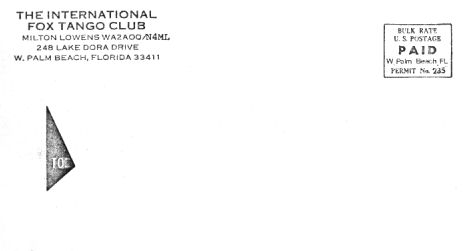
Over the 14 year span of the Fox Tango Newsletters, Milt mailed the publications from where he was. These locations included: New York, West Palm Beach FL, and Mexico. The earliest of the Newsletters were mailed in member-supplied SASEs. In fact, the original Newsletters had no mailing section whatsoever. They were simply folded and inserted into envelopes and mailed. I do not have an image of those mailings. Later Newsletters did have a postal-friendly layout as the Newsletter format changed to the familiar 8-1/2"x11" and were folded in half prior to being mailed. Cancelled stamps can be seen. Eventually, Milt obtained Postal Permits during the peak years of the publication process which lasted thru the last issue in 1985. From 1977 thru 1985, all publications are from Milt's home in W. Palm Beach, FL.Image of a March 1974 edition postmarked from San Miguel Mexico, dated 19FEB74. Milt's callsign is WA2AOQ.

Image of a June 1974 edition postmarked from the Bronx NY, dated 28May74. Milt's callsign is WA2AOQ.
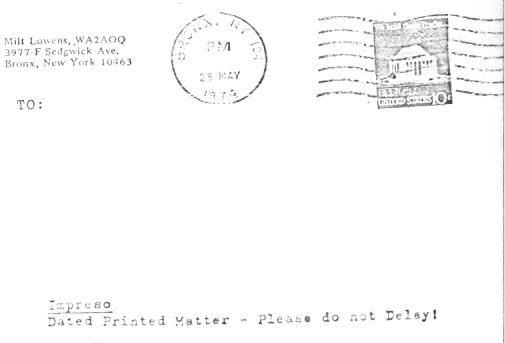
Image of a March 1975 edition postmarked w/Bulk Rate from the Bronx NY, undated. Milt's callsign is WA2AOQ.
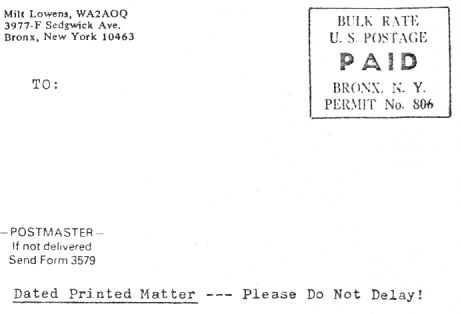
Image of a October 1977 edition postmarked W. Palm Beach, FL, undated. Milt's callsign is WA2AOQ/4.
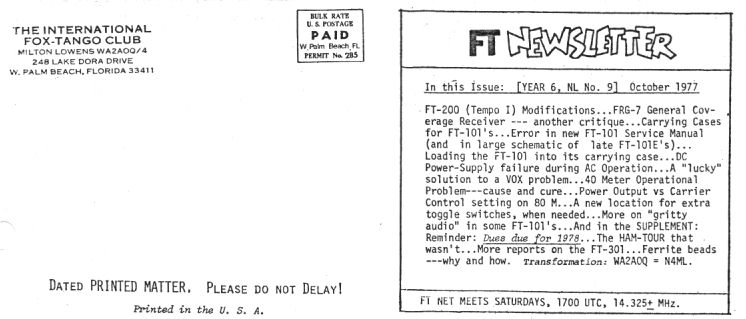
Image of a June 1978 edition postmarked from W. Palm Beach, FL, undated. Milt's callsign is WA2AOQ/N4ML.
So What did it Look Like?
It would be a disservice to simply scan and post the Fox Tango Newsletters in their image form. I would hope that over the years that the Newsletters will be scanned and indexed by keyword for ease of searching. Until such time, I offer two (2) examples of the Newsletters. The first is the original (1972) mimeograph layout and a later (1975) in 8-1/2"x11" layout which includes the very first look at the Fox-Tango logo!Image of a July 1972 inside page showing the original mimeograph layout and the 8-1/2"x14" long format.

Image of the April 1975 cover page showing the Fox-Tango Logo for the very first time. Note the 8-1/2"x11" format.