 GOD BLESS OUR TROOPS !!
GOD BLESS OUR TROOPS !!
GOD BLESS OUR TROOPS !!
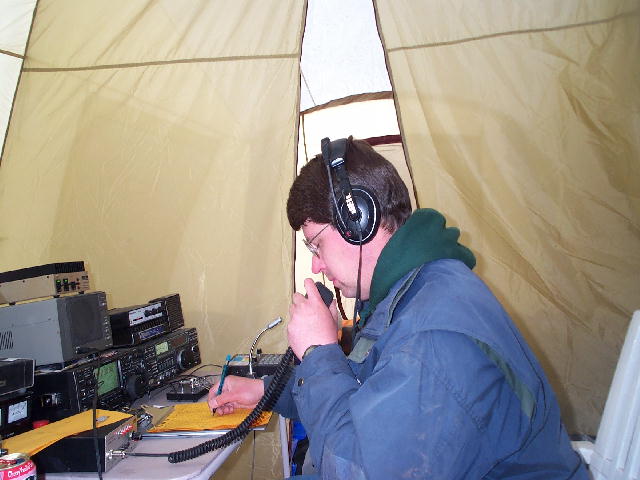
The picture above is me operating 2 meters on Pine Mountain CN93 in Oregon for the K7CW Unlimited multiop in June 2002
UPDATE NOVEMBER 2016
I forgot about this site I created many years ago to learn HTML. I typed the whole thing on a text editor as I learned. I decided to log back in to delete the outdated links and update some info. I have been WAY behind responding to paper QSL requests as I ran out a couple years ago. I have new QSL cards and I am trying to answer all who sent me a card with an SASE. I am now on LOTW and have uploaded my current logs back to mid 2008. I am SLOWLY entering old paper logs back to 1990. Most of my MAJOR contest logs that had a cabrillo file back to 2002 have been uploaded. I still VHF contest and enjoy chasing DX on HF as well as HF contesting. I am also a CW operator for the W7PU club call in many contests.
-ABOUT ME-
My name is Eric and I live in Tacoma, WA grid square CN87rf. I am 51 years old, hold an Amateur Extra class license, and have been a ham since Sepember 1978. I currently operate HF through microwave frequencies. I was fascinated by 6 meter propagation by observing other stations use the band for over 10 years before I finally got into VHF weak signal operation myself in 1995 when I built a Ten Tec 6 meter transverter kit. I then added a Down Eeast Microwave 2 meter transverter after missing out on a 2 meter sporadic E opening. Bands up to 3.4 GHz on my tower and up to 10 GHz portable have been added since. I worked the world on HF CW with 100 watts and a triband beam on the roof but VHF operation has been very enjoyable because it is so exciting to hear distant signals that "should not make it past line of sight". I have contacted over 300 grid squares from all over the world on 6 meters and 71 grids in 13 western states, British Columbia, and Alberta Canada on 2 meters. I have even worked 7 states and B.C. Canada on 222 MHz. However I can and do still get on HF (160 to 10 meters) as well. I enjoy VHF contesting and did portable "mountain topping" for a while. I have operated from Mt. Crag (CN87) with K7VHF multiop and by myself, West Rock (CN87), Rock Candy Mtn. (CN87) with K7VHF multiop, Table Mtn. (CN97) with K7CW multiop , Mt. Emily (DN05) with K7CW multiop, Pine Mtn. (CN93) K7CW again, and Mt. Brenton (CN88) in B.C. Canada as VA7ISL with Gabor VE7DXG , Neil VA7DX, and Dale VE7DDK. I operated from Minot Peak in CN86 for the 2003 144, 222, 432 MHz and 2004 6 meter Spring Sprints. I have also operated as a "rover" a few times. The first was in June 1999 and I activated 3 grids. I set up and tore down the station each time off of the back of my truck. Man what a work out that was! But it was fun! I also roved in the Spring and Fall 2002 6 meter sprints and the 2003 Spring 6m sprint. Now in 2016 I still enjoy HF DXing and contesting as well as VHF contesting and chasing grid squares but staying home.
-METEOR SCATTER-
I made my first WSJT FSK441 mode meteor scatter contact with W1IPL in DN62 on Dec 14, 2002 for a new grid and state on 2 meters!! I built my own computer/ radio interface with transformer isolation on TX and resistor attenuation on RX. I use an opto isolator for PTT control. I tested the interface with PSK31 on HF as there are plenty signals to copy to get the levels set and make sure it worked. PSK31 was interesting but my main goal was to get on the WSJT modes: FSK441 and JT44. I worked a couple locals on FSK441 and then ran a sked with W1IPL and completed!!! I later made a contact with KF6BXH in CM87 on my CQ! My best distance so far is WB2FKO in DM65rc New Mexico at 1177 miles on 2 meters. We completed on Jan 3, 2004 at 0736 UTC after running for just under an hour.
I have completed many SSB meteor scatter contacts and even one CW QSO at about 30 wpm in the past. I missed the HSCW craze but I enjoy WSJT modes. I have not used it in quite a while so I am a bit rusty but I want to get back into WSJT again on VHF.
The following is a rundown of my VHF station:

I am charter member number 21 of the Pacific Northwest VHF Society which serves the Northwest corner of the USA and Canada. We have almost 600 members!
PICTURES FROM PLACES I HAVE RECENTLY OPERATED
For September 2004 I went to Pock Peak in the West side of CN96. Lynn N7CFO also operated up there along side of me. I ran out of the back of my truck for the first time and it was a little cramped but not bad. I also used minimal antennas to keep the setup simple. The pictures will be posted soon- check back!.
June 2004 took myself, K7CW, KE7V, VE7DXG, K7ND, W7YOZ, and K7WIA back to Table Mountain for the ARRL VHF QSO Party for a unlimited multiop effort that broke the Northwest Division multiop record with 205,716 points!
In June 2003 I went to 6300 ft Lion Rock on Table Mt. in CN97 with Paul K7CW and Mike K7MDL for the ARRL VHF QSO Party. I opearted 2 meters for our Multi Unlimited effort and I dare say this was the best location I have been to as far as RF propagation is concerned in Washington! These are some pictures of the operation courtesy of Mike K7MDL.
I operated from CN88 on Mt. Brenton, B.C. Canada for the September 2002 contest. My host was Gabor VE7DXG and we operated from the Cowichan Valley ARC repeater site at 4000 feet using tha call VA7ISL. Neil VA7DX and Dale VE7DDK aslo joined us for the multiop effort. We had some interference from the repeater but we dealt with it. I had a ton of fun and look foreward to going back someday! These are the the pictures from Mt. Brenton.
Here are some pictures from the June, 2002 K7CW Pine Mountain, OR operation in CN93 with Eric KB7DQH, Paul K7CW, and myself. Many thanks to Alan KC7NAA at the Pine Mountain Observatory for helping us get a good spot at the top of the mountain!
Links to recources I like to use:
Directive Systems Makers of microwave band loop yagis and K1FO yagis.
M squared antennas. Some of the best around!
Down East Microwave. Both kit and assembled VHF through 10 GHz transverters!
Or how about beam antennas for not a lot of money? WA5VJB has plans for easy to build yagis that don't cost an arm and a leg.
Well thanks for looking at my attempt to learn HTML!! New things will be added as I learn more and think of what to add.
73 de Eric N7EPD
©2016 Eric Olson N7EPD