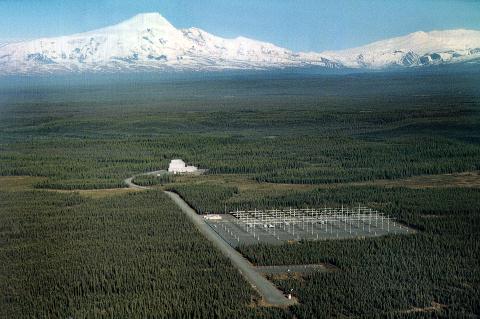

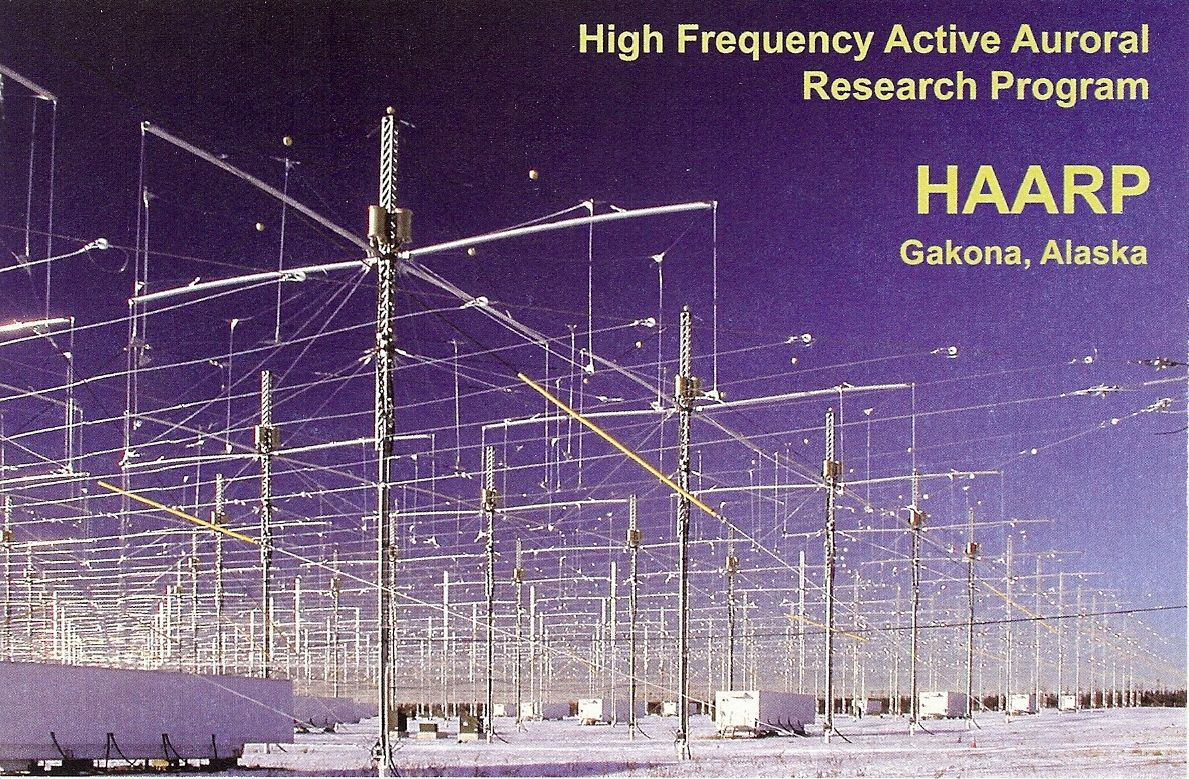
The High Frequency Active Auroral Research Program (HAARP) is an investigation project to "understand, simulate and control ionospheric processes that might alter the performance of communication and surveillance systems." Started in 1993, the project is proposed to last for a period of twenty years.The project is jointly funded by the United States Air Force, the Navy, and the University of Alaska. Defense Advanced Research Projects Agency (DARPA). The project site is north of Gakona, Alaska (lat. 62�23'30 N, long 145�09'03 W). The HAARP has been constructed at the previous site of an over-the-horizon radar installation.
|
|
EME communications had previously been achieved on VHF, UHF and microwave frequencies where the ionosphere is transparent and the required high gain antennas to overcome path loss are more easily achieved. The goal of this experiment was to attempt EME radio communication in the high frequency (HF) spectrum (short-wave radio frequencies below 30 MHz). The HAARP array would direct its total output power in a focused beam tracking the moon. This experiment was conducted during the sunspot cycle minimum when the ionosphere is least reflective to HF radio signals and during the winter when atmospheric noise is also at a minimum.
The
University of New Mexico Long Wavelength Array (LWA) also
participated in the experiment.
|
|
The project designers suspected that the test
signals might be detectable with a simple short wave receiver
and antenna, so they invited short wave listeners and amateur
radio operators around the world to participate in the
experiment and to submit reception reports. The antenna I
used was a 100 foot random wire antenna raised 20 feet above the
ground and a Kenwood TS-140s receiver. The receiver was
placed in the CW narrow mode (500 Hz bandwidth) and tuned for a
800 Hz tone centered in the filter passband. The audio
signals from the radio's headphone jack were fed through a patch
cable directly to the microphone input of a Hewlett Packard
laptop computer, and the signals were recorded as a WAV file and
analyzed with a program called Spectran. (Spectran
is a signal analysis program for Windows written by Dr. Alberto
Di Bene and freely available for download at http://www.weaksignals.com/).
The transmission schedule:
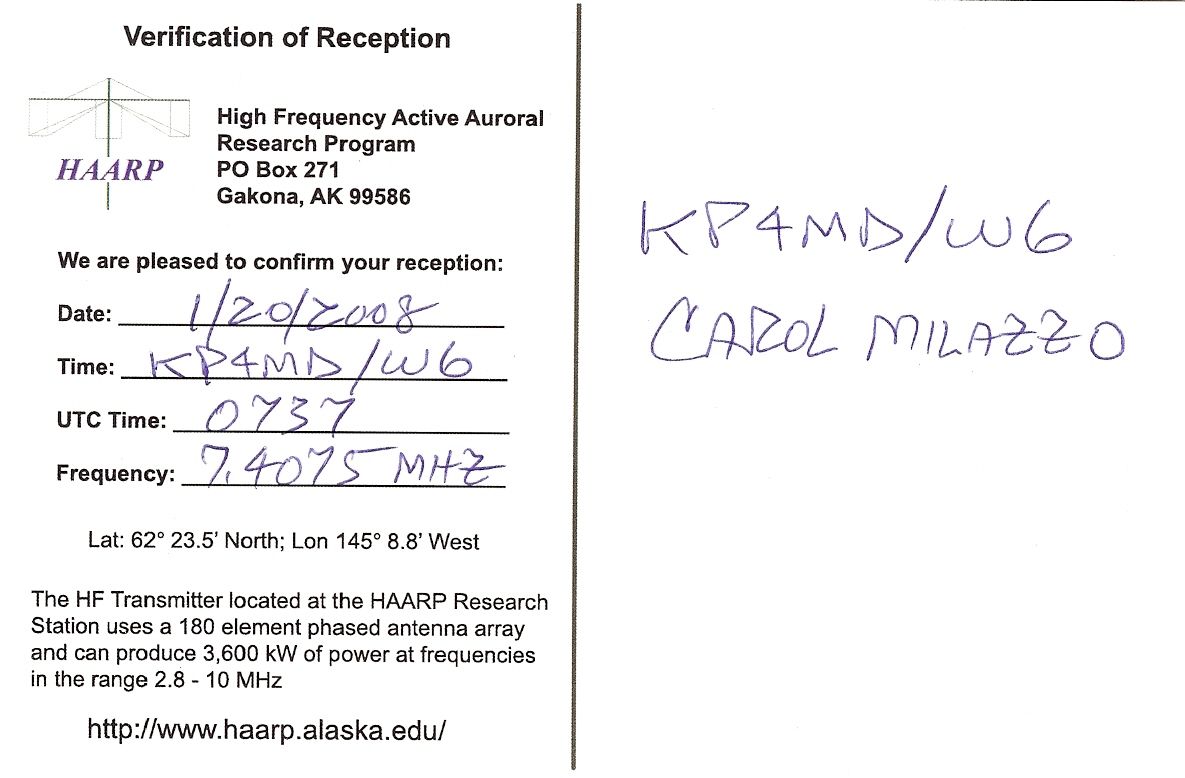
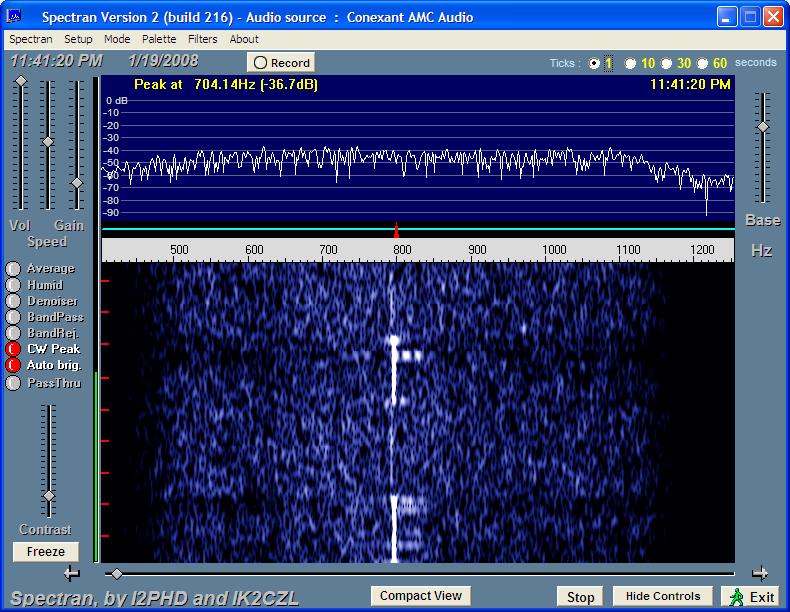 Reception report at KP4MD: HAARP - LWA
Moon Bounce Signals on 20 JAN 2008 at 0737Z on 7407.5 kHz HAARP
signal varied from 8-9 S units (20-30 dB over noise level)
Echos were detected after about 1 out of every 10 transmissions
(maximum 5 dB over noise level). In the bottom window of
this Spectran display, the heavy white vertical line segments
represent the 2 second HAARP transmissions received via
ionospheric scatter (click on the image to enlarge for
detail). The fainter thin white line segments connecting
the brighter ones represent the signals reflected from the lunar
surface.
Reception report at KP4MD: HAARP - LWA
Moon Bounce Signals on 20 JAN 2008 at 0737Z on 7407.5 kHz HAARP
signal varied from 8-9 S units (20-30 dB over noise level)
Echos were detected after about 1 out of every 10 transmissions
(maximum 5 dB over noise level). In the bottom window of
this Spectran display, the heavy white vertical line segments
represent the 2 second HAARP transmissions received via
ionospheric scatter (click on the image to enlarge for
detail). The fainter thin white line segments connecting
the brighter ones represent the signals reflected from the lunar
surface.
Feedback from HAARP-LWA Moonbounce Experiment: �Thanks to all who participated on the first evening of this experiment. We have received over 550 reports from North America, Australia, Pacific islands, and from many European countries. All of the reports will be useful and ones that contain audio recordings and other recorded data sets will be especially valuable.�
How to recreate the experience of receiving
and analyzing the HAARP-LWA signals on your personal computer.