|
Juneau Amateur Radio Club, Inc. |
|
Amateur Radio Emergency Service
Nick left 5 Pac Com Tiny-2 TNC's from the State to develop a packet node in the Juneau area. They'll need power supplies and cables, and will require some radios to put the nodes together. We will also need some means to program the EPROM's. If anyone has the means/knowledge/abilities/interest (any of these will do) to take on this project please let me know.
Northern Southeast Alaska ARES We are comprised of members of the Juneau Amateur Radio Club who have a desire to provide communications in the event of an emergency. We not only have members in all parts of Juneau, but Gustavus, Haines and Hoonah.
In addition to emergency communications we provide communications for
special events including the 4th of July parade, Ski-to-Sea and
other trail runs and events. We use the JARC linked repeater system for our weekly net, which provides coverage from Juneau to Haines. When our new repeater in Hoonah is completed our coverage will be greatly expanded. Should all parts of the JARC repeater system fail we also have the ability to use a “stand alone” repeater at Pederson Hill, which covers most of the Juneau area. Training for ARES members is provided on-line with our extensive links to training material in addition to the weekly net. We also participate in the annual Field Day , the Simulated Emergency Test, the annual national SkyWarn net and other “on air” events. For additional information contact , Patrick Cuddihy AL7I, Emergency Coordinator Northern Southeast Alaska Amateur Radio Emergency Services.
The Amateur Radio Emergency Service (ARES) net meets on 146.82 and 147.00 Mhz at 19:00 on Tuesdays.
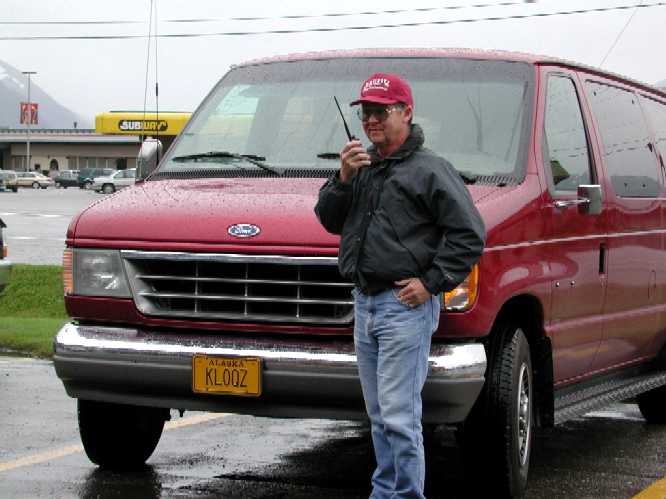
Glenn Sicks, KL0QC
From the ARRL Letter, Vol 21, No 26, Friday 28th June 2002 ARRL HQ
MEETING EXPLORES ENHANCED PUBLIC SAFETY ROLE FOR AMATEUR RADIO
(reprinted with the permission of the ARRL Letter
and The American Radio Relay League) Exploring an enhanced post-9/11 public
safety and homeland security role
for Amateur Radio was the focus of a National
Public Safety
Telecommunications Council (NPSTC) Amateur
Radio Working Group meeting
June 25. ARRL President Jim Haynie, W5JBP,
hosted the daylong session at
ARRL Headquarters which included participation
by several ARRL staff
members.
"It's our goal to increase the credibility
of the Amateur Radio Service,
especially after 9/11," Haynie said. "We
know we have a great service that
we can offer, and the resources are at
no cost to the taxpayer, and it
just makes good sense to us to use the
Amateur Radio operators of America
to help with homeland security and defense."
ARRL Field and Educational Services Manager
Rosalie White, K1STO, briefed
the gathering on ARRL's Amateur Radio Emergency
Communications on-line
training course series <
http://www.arrl.org/cce/courses.html
>. Copies of
the Level I emergency communications course
were distributed to meeting
participants for their suggestions and
comments.
Chairing the session was Gene McGahey,
AL7GQ, who is deputy manager of
Communications Technology Technical Assistance
for the National Law
Enforcement and Corrections Technology
Center. NPSTC
<
http://www.npstc.org/
>--pronounced "nipstick"--is a coalition of
organizations involved in public safety
communications. ARRL is a NPSTC
participant. This week's meeting was a
followup to a brainstorming session
last February in Washington, DC, in which
ARRL took part.
McGahey said discussion this week included
the public safety aspects of
the proposed secondary domestic amateur
allocation at 5 MHz; the relevance
of accreditation and training programs
and their role in validating
Amateur Radio's participation in public
safety communications support; the
potential of 4.9 GHz to relieve public
safety pressure from 2.4 GHz; and
proposed research involving Amateur Radio's
public safety role. Two
surveys are under consideration for sometime
within the next 12 months.
One would determine Amateur Radio's specific
emergency resources and
capabilities. A second would assess the
utilization and need for Amateur
Radio resources by public safety officials.
Haynie said after the meeting that he's
optimistic about Amateur Radio's
greater involvement in public safety and
homeland security communications.
"It's a whole new mindset since September
11," he said, "and we now need
to pay attention to how all Americans--whether
they're in public safety or
Amateur Radio--can cooperate to make this
a safer nation."
Since June 12, 1999 you are visitor
number This page was last Updated on: 03/14/03 |
|
Copyright, 2001,2002, 2003 Juneau Amateur Radio Club, Inc. All Rights Reserved. |