Membership # 4322


Next page
Home

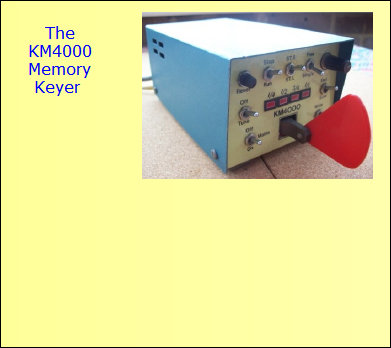
I designed the KM4000 in the late 80's to fulfil a need for a flexible electronic morse key with a built in electronic memory that can be used for every day QSO’s, contest, meteor scatter or EME work. The KM4000 was designed with the user in mind and can be operated with a single paddle or with full iambic operation, there’s an LED memory status display and side tone generator, just add the switch options, put it in all in a case and connect your favourite paddle. . . You may need a TX to get some distance.
Many many years ago when I was eleven my interest in amateur radio or ham radio as its come to be known started. The idea of talking through a microphone and those words being heard miles away fascinated me. (Still does).
Many hours were spent reading radio magazines and cannibalising old televisions and radios for components, some of the more ‘likely’ radios had BFO’s, ’S’ meters, additional IF stages and RF pre-selectors added. Transmitters were made and remade. At thirteen the ‘Radio Amateurs Exam’ was taken. The result was not what I wanted. I got round to taking it again a few years later with the correct result this time; In 1975 G8KLN was on the air. Using modified commercial equipment and home brew my interest was 2 metre DX.
A couple of years later in 1977 my interest turned to CW and the Morse test. After 3 months living, breathing and eating Morse the CW test was in the bag. G4GVB had arrived. While I was working in the Design and Development department at a company in West Sussex producing Digital Temperature measuring equipment. I designed, built and sold an electronic Morse key with memory, the KM4000 was published in the RSGB’s magazine ‘Radio Communication’ I still have the original keyer and it still works. In 1998 I was elected a 'Fellow of the Institute of British Engineers'.
Today at my modest size QTH my interest is DX both QRO and QRP also giving a few points away in contests. I work all the HF bands with an FTDX101D and an Acom 1000 linear giving me an easy 400 watts. For VHF / UHF and Satellites I'm using an FT-847. Most of my time is on HF using SSB, CW, PSK, SSTV, JT65, JT9, FT8, ROS, OPERA, WSPR, HELL & RTTY.
I like to work towards different eQSL awards I have the various eDX100, ePFX300, eCanada, eJapan, eAustralia, eZ40, eWAC and some of the eEurope and FT8 awards.
I am now retired from main stream work, but I'm currently working for eQSL as an Advisory Board member and I'm the award manager for the eDX100 series and eUK awards. (I don't approve my own awards)
Other interests include Flying (I have a multi-engine Private Pilots Licence), Scuba Diving (I have a PADI Staff Instructors Rating) and Cycling (I have a bicycle).
You can also find me on QRZ.com.